
This guide will walk you through integrating Claudery with your BigCommerce store. BigCommerce uses store-level API credentials that are created directly in your store’s control panel. You’ll need to create a store-level API account to connect your store to Claudery.
Prerequisites
- Active BigCommerce store with admin/owner access
- Claudery SaaS account and access to the Claudery dashboard
Step 1: Access Store-Level API Accounts
1.1 Log in to BigCommerce
- Log in to your BigCommerce control panel
- Navigate to Advanced Settings → API Accounts
- You’ll see a list of existing API accounts (if any)
Important: BigCommerce uses store-level API accounts. These are created directly in your store’s control panel, not in a separate developer portal. The API credentials you create are specific to your store.
Step 2: Create Store-Level API Account
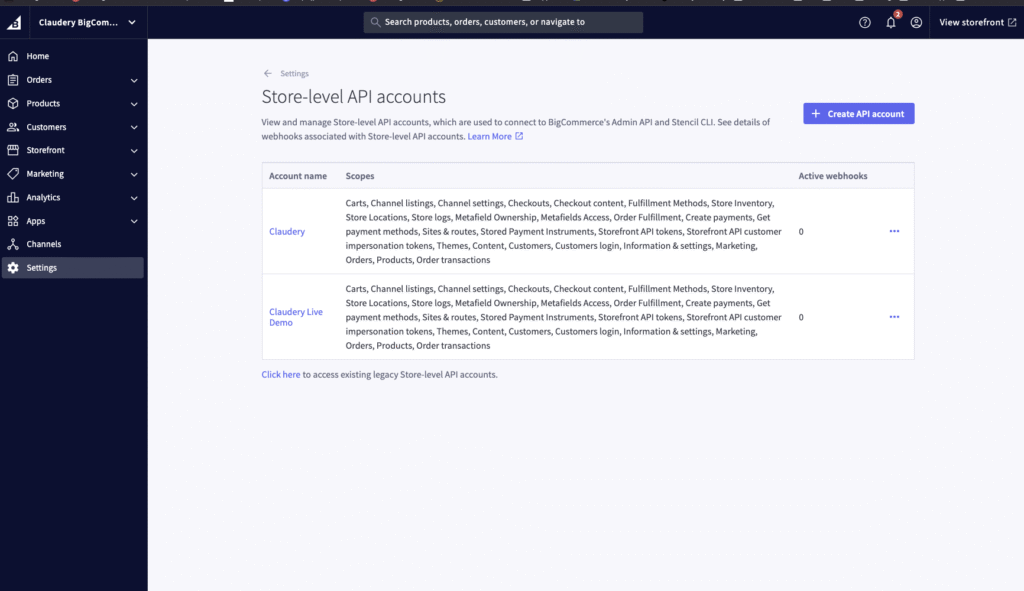
2.1 Create New API Account
- Click the Create API Account button (or Create V2/V3 API Token)
- Enter an account name (e.g., “Claudery AI Integration”)
- Select the API scopes/permissions you need:
- Products – Read and modify products
- Orders – Read order information
- Customers – Read customer information
- Catalog – Read catalog information
2.2 Save and Get Credentials
- Click Save to create the API account
- BigCommerce will display your API credentials
- You’ll see the following information:
- API Path – Contains your store hash (e.g.,
https://api.bigcommerce.com/stores/abc123/v3/) - Client ID
- Access Token – This is your API access token
- API Path – Contains your store hash (e.g.,
- Copy all credentials immediately – the Access Token is only shown once
Important: Copy the Access Token immediately and store it securely. The token will only be displayed once. If you lose it, you’ll need to create a new API account.
Step 3: Extract Store Hash from API Path
3.1 Get Store Hash
- From the API Path provided by BigCommerce, extract your store hash
- The API Path format is:
https://api.bigcommerce.com/stores/{store-hash}/v3/ - The store hash is the value between
/stores/and/v3/ - Example: If API Path is
https://api.bigcommerce.com/stores/abc123/v3/, your store hash isabc123 - Alternatively, if your store URL is
https://store-abc123.mybigcommerce.com, your store hash isabc123
Step 4: Get Account UUID (If Required)
4.1 Find Account UUID
- Account UUID is typically only needed for multi-store accounts or account-level API access
- For store-level API accounts (which is what we’re using), Account UUID may not be required
- If Account UUID is needed, you can find it in:
- BigCommerce Developer Portal (developer.bigcommerce.com) if you have account-level access
- Your BigCommerce account settings
- Or contact BigCommerce support
- Note: For most store-level integrations, Account UUID can be left blank
Step 5: Configure Claudery Platform Settings
5.1 Access Claudery Dashboard
- Log in to your Claudery SaaS dashboard
- Navigate to your merchant site settings
- Go to the Quick Start section or Platform Settings
5.2 Select BigCommerce Platform
- Select BigCommerce as your e-commerce platform
- This will display the BigCommerce-specific credential fields
5.3 Enter Store Hash (Required)
- Paste your Store Hash into the Store Hash field
- This is the store hash you extracted from the API Path in Step 3
- Do not include the “store-” prefix – just the hash itself (e.g.,
abc123) - Alternatively, you can enter your store URL and the system will auto-extract the hash
5.4 Enter Client ID
- Paste your Client ID into the Client ID field
- This is the Client ID from your store-level API account
- Ensure there are no extra spaces
5.5 Enter Access Token (Required)
- Paste your Access Token into the Access Token field
- This is the Access Token from your store-level API account
- Ensure there are no extra spaces
5.6 Enter Account UUID (Optional – for Multi-Store Accounts)
- If you have multiple stores or need account-level access, enter your Account UUID
- For single-store integrations, this field can typically be left blank
- If provided, use the full UUID format (e.g.,
34b5266e-xxxx-xxxx-xxxx-xxxxxxxxxxxx)
5.7 Enter Client Secret (If Required)
- If Client Secret is required for your account type, paste it into the Client Secret field
- For store-level API accounts created in the control panel, Client Secret may not be required
- Check the API account details in BigCommerce to see if Client Secret was provided
5.8 Test Connection
- Click the Test Connection or Save & Test button
- Wait for the connection test to complete
- If successful, you’ll see a confirmation message
- If there’s an error, verify all credentials are correct
Step 6: Sync Products
6.1 Initial Product Sync
- After successful connection, navigate to the Product Sync section
- Click Sync Products or Initial Sync
- Wait for the sync process to complete
- Monitor the progress – larger catalogs may take several minutes
6.2 Verify Sync
- Check the sync status in the dashboard
- Review the product count to ensure all products were synced
- If any products failed to sync, check the error logs for details
Step 7: Configure Widget Settings
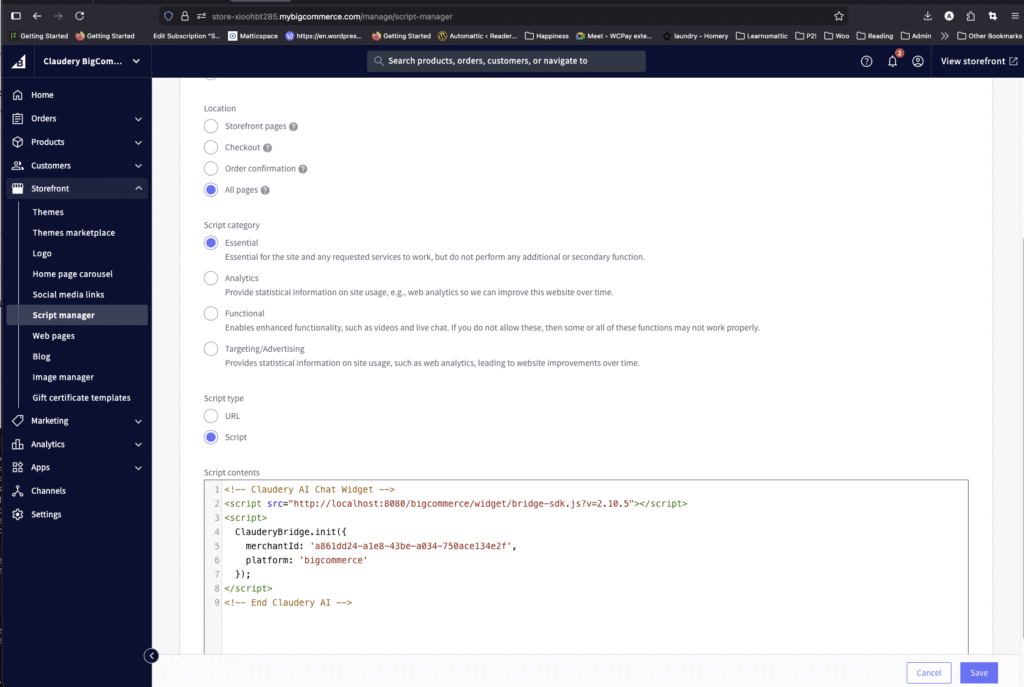
7.1 Get Widget Embed Code
- Navigate to Widget Settings in your Claudery dashboard
- Copy the provided JavaScript embed code
7.2 Add Widget to BigCommerce Theme
- In BigCommerce control panel, go to Storefront → Theme Editor
- Navigate to Footer or Global Footer template
- Add the Claudery widget script before the closing
</body>tag - Save and publish your theme
Troubleshooting
Connection Errors
- Verify your Store Hash is correct (extracted from API Path or store URL)
- Ensure your Client ID and Access Token are copied correctly (no extra spaces)
- Check that the API account has the required scopes/permissions
- Verify the API account is active in BigCommerce
- Ensure you’re using store-level API credentials (created in Advanced Settings → API Accounts)
- If Account UUID is required, verify it’s in the correct UUID format
- For store-level API accounts, Client Secret may not be required – check BigCommerce API account details
Sync Issues
- Check that products exist in your BigCommerce store
- Review error logs in the Claudery dashboard for specific error messages
- Verify your API scopes include product read permissions
- Check BigCommerce API rate limits if sync is intermittent
- Ensure the store hash is correct if you have multiple stores
Credential Issues
- If Access Token is lost, you’ll need to create a new store-level API account (tokens are only shown once)
- Store-level API accounts use simple token authentication (not full OAuth flow)
- Ensure you’re using store-level API credentials, not account-level credentials
- Verify the store hash matches your store (check your store URL format)
- If you have multiple stores, create separate API accounts for each store
Security Notes
- Keep all API credentials secure – treat them like passwords
- If credentials are compromised, revoke the API account in BigCommerce and create a new one
- Use the minimum required API scopes for security
- Regularly review API accounts and their permissions in BigCommerce
- Monitor API usage and set up alerts for unusual activity
- Consider using environment variables to store credentials securely
API Information
Claudery uses BigCommerce Store-Level API V3 for all operations. The integration uses store-level API credentials, which means:
- API accounts are created directly in your store’s control panel (Settings → API Accounts)
- Credentials are specific to your store (store hash is required)
- Store hash is extracted from the API Path provided by BigCommerce
- The integration uses the store-level API endpoint:
https://api.bigcommerce.com/stores/{hash}/v3/ - Supports cursor-based pagination for efficient data retrieval from large catalogs
Next Steps: Once integration is complete, you can customize your AI assistant settings, configure product search preferences, and start using Claudery’s AI-powered shopping features on your BigCommerce store.